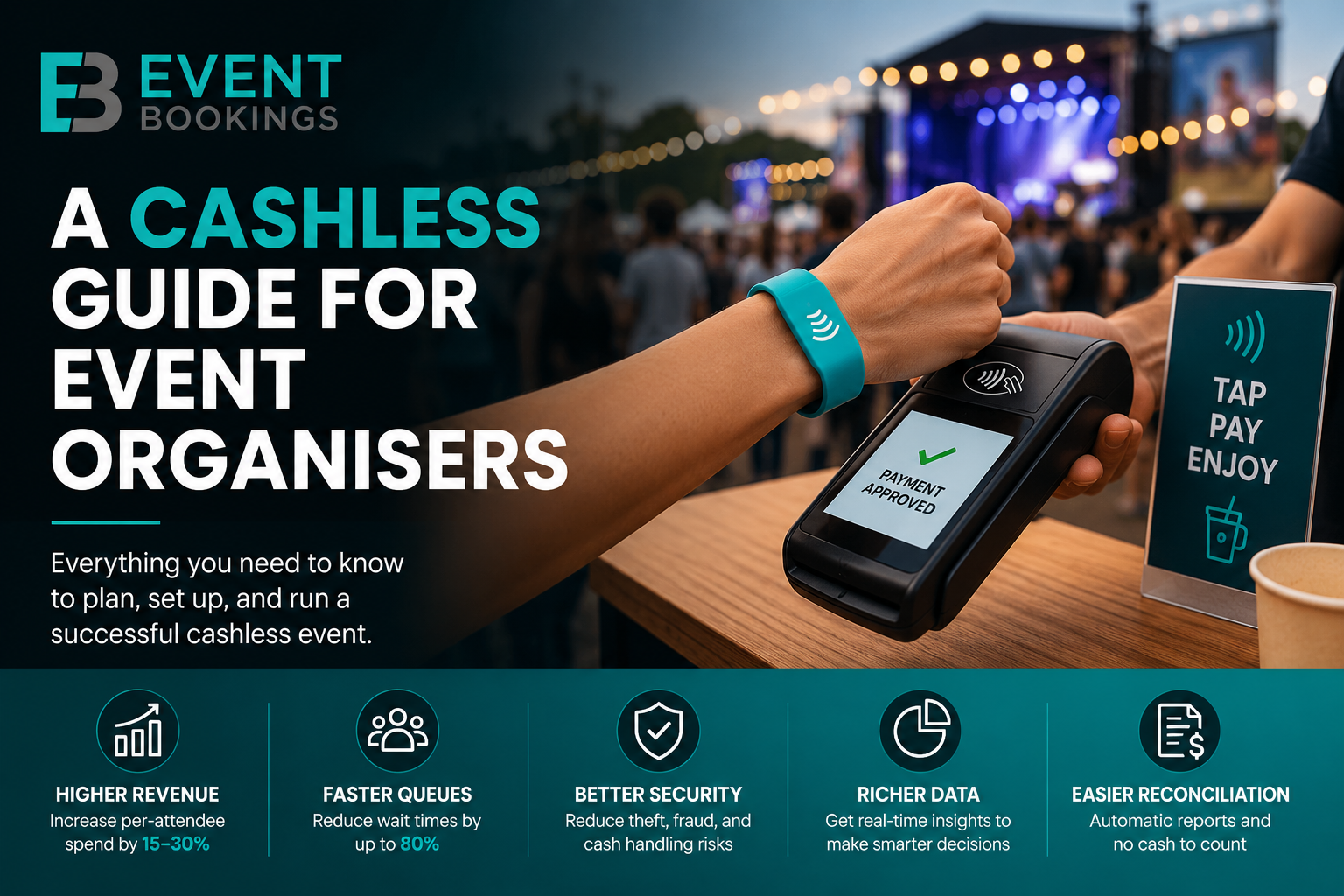
Going cashless at your event is no longer a bold experiment — it’s quickly becoming the baseline expectation. Attendees who tap their phone a dozen times a day for coffee, groceries, and transit don’t want to fumble for notes at your food stall. And for organisers, the benefits go well beyond convenience.
This guide explains what a cashless payment system is, why it matters, the types of systems you can use, how to set one up, and what to look out for during the process.
What Is a Cashless Event?
A cashless event is one where physical cash is replaced entirely (or largely) by digital payment methods. Rather than accepting notes and coins, vendors at a cashless event process transactions through one of several digital systems — NFC wristbands, RFID cards, contactless card terminals, mobile wallets, or a dedicated event app.
Attendees either load credit onto a wearable device before or during the event, or they pay directly with their contactless card or phone at point-of-sale terminals. Either way, no physical cash changes hands.
Cashless events span all formats — from multi-day music festivals and food markets to corporate conferences, sporting events, and trade expos. The underlying technology varies, but the goal is the same: faster, more secure, more trackable transactions.
Why Go Cashless? The Benefits for Organisers
The case for going cashless is compelling on multiple fronts. Here’s what the data and real-world experience tell us.
1. Significantly Higher Revenue
This is the headline benefit. Events deploying cashless systems consistently report per-attendee spending increases of 15–30% compared to cash-based equivalents. Some festivals have reported even higher gains — Tomorrowland, for example, reported a 30% increase in on-site spending after transitioning to cashless payments.
Why does spending go up? It all comes down to psychology. When attendees use pre-loaded credits or tap a wristband, the cognitive “pain” of giving physical money disappears. Spending feels easier and less final — and that directly translates into more purchases. Pre-event top-up incentives (e.g. “load $50 and get $5 free”) also encourage attendees to commit to higher budgets before they even arrive.
There’s also a revenue opportunity in unspent balances. Studies of European festivals found that around 11% of loaded funds went unspent by event end — funds that, depending on your refund policy and transparency with attendees, can represent meaningful additional income.
2. Faster Transactions and Shorter Queues
Cashless payments are much faster than cash. RFID and NFC transactions take less than two seconds, while cash or card payments can take 15 to 30 seconds. Studies show this speed can cut queue times by up to 80%.
For attendees, shorter queues mean more time enjoying your event. For organisers, faster throughput means more sales opportunities during peak windows — like the 30-minute break between acts when hundreds of people all want a drink at once.
3. Better Security and Reduced Fraud
Cash can be risky. It might be stolen, faked, or miscounted. A cashless system removes these risks. Every transaction is recorded automatically, so you have a full and secure audit trail. If a wristband or card is lost, you can deactivate and replace it, and the balance stays safe.
For multi-vendor events, this also resolves accountability concerns. Organisers can track sales by vendor, by terminal, and by time period, making it far harder for funds to go unaccounted for.
4. Richer Data and Analytics
One big benefit of going cashless is the data you collect. Each transaction tells you what was bought, when, where, and for how much. Over time, this information helps you:
- Identify your busiest sales windows and staff accordingly.
- Spot your top-performing vendors and negotiate better terms.
- Understand which areas of your venue are under or over-serving demand.
- Customise future events to match what attendees actually spend on.
This data is gold for long-term event growth — and it’s simply not available when you’re operating on cash.
5. Simpler Financial Reconciliation
Balancing cash at the end of a big event is slow, stressful, and easy to get wrong. A cashless system does this work for you. Totals are updated in real time, reports are instant, and there’s no cash to count or deposit. For events with many vendors, this alone makes cashless worth it.
The Different Types of Cashless Systems
Not all cashless systems are built the same. The right choice for your event depends on its size, audience, venue infrastructure, and budget.
Closed-Loop Systems (RFID/NFC Wristbands or Cards)
This is the most common setup for festivals and large events with many vendors. Attendees get a wristband or card with prepaid credit. They tap to pay at any vendor, and the money stays within your event.
Best for: Festivals, multi-day events, large-scale outdoor events
Advantages:
- Works offline — transactions are stored on the device and synced later, so connectivity issues don’t halt sales
- Complete financial control — you see every cent spent across your event
- Can double as an access pass, age verification token, or loyalty card
- Higher average spend per attendee due to the psychological effect of pre-loaded credit
Considerations:
- Requires hardware investment (wristbands, cards, terminals)
- Attendees need to top up in advance or on arrival — add clear signage and multiple top-up stations
- Refund processes for unspent credit need to be communicated clearly and handled fairly
Open-Loop Systems (Contactless Cards and Mobile Wallets)
Open-loop systems accept standard contactless bank cards and mobile wallets (Apple Pay, Google Pay) without requiring any pre-loading. Attendees simply pay the same way they would in any shop.
Best for: Smaller events, venue-based events, conferences, pop-ups
Advantages:
- No onboarding friction — attendees don’t need to do anything differently
- No hardware other than card terminals required
- Familiar and trusted by attendees
Considerations:
- Requires reliable internet connectivity for payment processing
- Less financial control — you lose the closed-loop spending analytics
- Transaction fees apply to each payment
App-Based Cashless Systems
Some events use a dedicated event app as the payment mechanism. Attendees link a payment method to the app and pay by scanning a QR code or using NFC through their phone.
Best for: Tech-forward events, conferences, corporate events
Advantages:
- Rich integration with the rest of your event experience (schedules, maps, loyalty rewards)
- No physical hardware required for attendees
- Enables push notifications, personalised offers, and real-time updates
Considerations:
- Requires attendees to download and set up an app — adoption rates vary
- Relies on attendees having a charged smartphone throughout the event
- Higher development or licensing costs:
Hybrid Systems
Many larger events now run a hybrid model: closed loop wristbands as the primary system, with open loop contactless terminals as a backup. This captures the revenue and data benefits of closed loop while removing barriers for attendees who didn’t pre-load or prefer to pay by card.
How to Implement a Cashless System: A Step-by-Step Approach
Step 1: Define Your Goals
Before selecting a system, define your objectives. Whether your focus is reducing queues, increasing revenue, improving data insights, or minimizing staff time on cash handling, your priorities will determine the best fit.
Step 2: Select Your System and Provider.
Research providers that specialise in event cashless solutions. Look for:
- Proven track record at events of your scale.
- Offline capabilities (essential for outdoor or remote venues).
- Clear charges without any hidden fees
- Integration with your ticketing and access control systems.
- Responsive assistance throughout your event
Step 3: Plan Your Hardware Needs
Plan your event layout and figure out how many payment terminals each vendor area needs. As a rule, aim for no more than five people in line per terminal during busy times. Remember to spread top-up stations throughout your site, not just at the entrance. Most events use one top-up station for every 500 attendees.
Step 4: Communicate Clearly with Attendees
Clear communication is essential. Attendees should understand the system before arrival. Use email, your event website, and social media to:
- Explain how the system works
- Provide instructions for pre-loading credit
- Communicate your refund policy for unused balances
- Reassure attendees about what happens if a wristband is lost
- Confirm what, if anything, can be purchased outside the system
Early communication reduces confusion and top-up bottlenecks on the day.
Step 5: Train Your Staff and Vendors
Your cashless system is only as smooth as the people operating it. Run training sessions for all staff operating terminals — including vendors. Make sure everyone knows how to handle common issues: failed transactions, lost wristbands, top-up requests, and refund queries. Have a dedicated support team available throughout the event.
Step 6: Test Everything Before the Event
Test everything from start to finish before your event begins. Run test transactions on every terminal and check your top-up stations. Make sure your system works both online and offline. It’s much better to find problems before the event than when 200 people are waiting in line.
Step 7: Monitor in Real Time on the Day.
Use your system’s live dashboard to track sales by vendor and by zone throughout the event. If a particular area is congested, you can quickly send additional staff or terminals. If a vendor is dramatically outperforming others, that’s intelligence you can immediately act on.
Step 8: Reconcile and Report Post-Event
After the event, generate a comprehensive financial report. Analyze spending by vendor, time slot, and product type, and compare results to pre-event estimates. Use these insights to inform future event planning, including staffing, vendor selection, layout, and pricing.
Tackling Common Concerns
“What about the attendees who prefer cash?”
This is a valid concern and requires a thoughtful response. Most attendees are comfortable with digital payments, with mobile wallet use reaching 91% among consumers in 2025. However, some individuals, such as older attendees, those without bank accounts, or international visitors, may find cashless options challenging.
Practical solutions include:
- Staffing currency exchange or cash-to-credit conversion points at the entrance
- Accepting open-loop contactless alongside your closed-loop system
- Being transparent in your communications about which payment methods are accepted
A fully inclusive approach means no attendee feels excluded — and you don’t lose a single sale.
“What happens if the internet goes down?”
For closed-loop RFID/NFC systems, connectivity isn’t critical. Because credit is stored on the wristband itself, transactions can process offline and sync to the central system when connectivity is restored. This is one of the strongest arguments for closed-loop over open-loop in outdoor or remote venues.
For open-loop contactless systems, a connectivity failure is more disruptive. Always have a contingency plan — a backup terminal with a different SIM, a mobile hotspot, or a small cash float as an absolute last resort.
“Isn’t it expensive to set up?”
There are real upfront costs for cashless systems, including hardware, software licenses, and staff training. However, these costs are often offset by higher revenue (15–30% more per attendee), lower cash handling costs, and fewer losses from theft or errors. Many providers also offer hardware rentals, which helps smaller organisers manage costs.
“What about data privacy?”
Cashless systems collect transaction data, and attendees deserve to know how it is used. Be transparent in your privacy statement about what data is collected, how it is stored and whether it is shared with third parties. Collect only what you need, store it securely and comply with relevant privacy legislation (including Australia’s Privacy Act). Trust is an asset – treat attendee data accordingly.
The Future of Cashless Events:
According to recent market research, the global cashless event payments market was valued at approximately USD 6.7 billion in 2024 and is projected to reach USD 24.2 billion by 2033, growing at a CAGR of 17.8%. This reflects a major shift in how events operate, driven by increasing demand for faster, safer, and more seamless payment experiences.
Several innovations are accelerating adoption:
Biometric payments — fingerprint or facial recognition linked to a payment method — are already in pilot stages at some venues, promising even faster throughput than tap-to-pay.
Real-time personalisation is emerging through systems that can push targeted offers to attendees based on their purchase history during the event itself — a half-price second drink offer sent to someone who just bought a meal, for example.
Integration with loyalty programs is deepening, allowing attendees to earn and redeem rewards across multiple events from the same organiser or platform.
Sustainability tracking is also developing, with some platforms beginning to include carbon footprint data for event-related purchases — aligned with growing attendee interest in environmentally conscious events.
Cashless Checklist for Event Organisers
Use this checklist as a quick reference when planning your cashless rollout:
- Define your cashless goals (revenue, speed, data, security)
- Select a system type (closed-loop, open-loop, app, or hybrid)
- Choose and brief a provider
- Map hardware requirements across your venue
- Plan and position top-up stations (1 per 500 attendees as a guide)
- Draft your attendee communications (email, website, social)
- Publish a clear refund policy for unspent credit
- Plan for cash-inclusive attendees (conversion points or fallback options)
- Train all staff and vendors
- Test all hardware and connectivity before doors open
- Set up live monitoring dashboard for event day
- Run post-event report and apply learnings to next event
Final Thoughts
Going cashless is one of the highest-impact operational decisions you can make as an event organiser. The combination of higher revenue, faster service, improved security, and richer data creates a compounding advantage — each event you run cashless, you learn more, your attendees expect it, and the ROI becomes easier to measure.
The key to a smooth transition is preparation: the right system for your event type, clear communication with your attendees, thorough staff training, and a contingency plan for the unexpected.
EventBookings integrates with leading cashless and ticketing solutions to give organisers a complete, end-to-end event management platform. Whether you’re running your first cashless event or scaling an established one, we’re here to help you make it seamless.