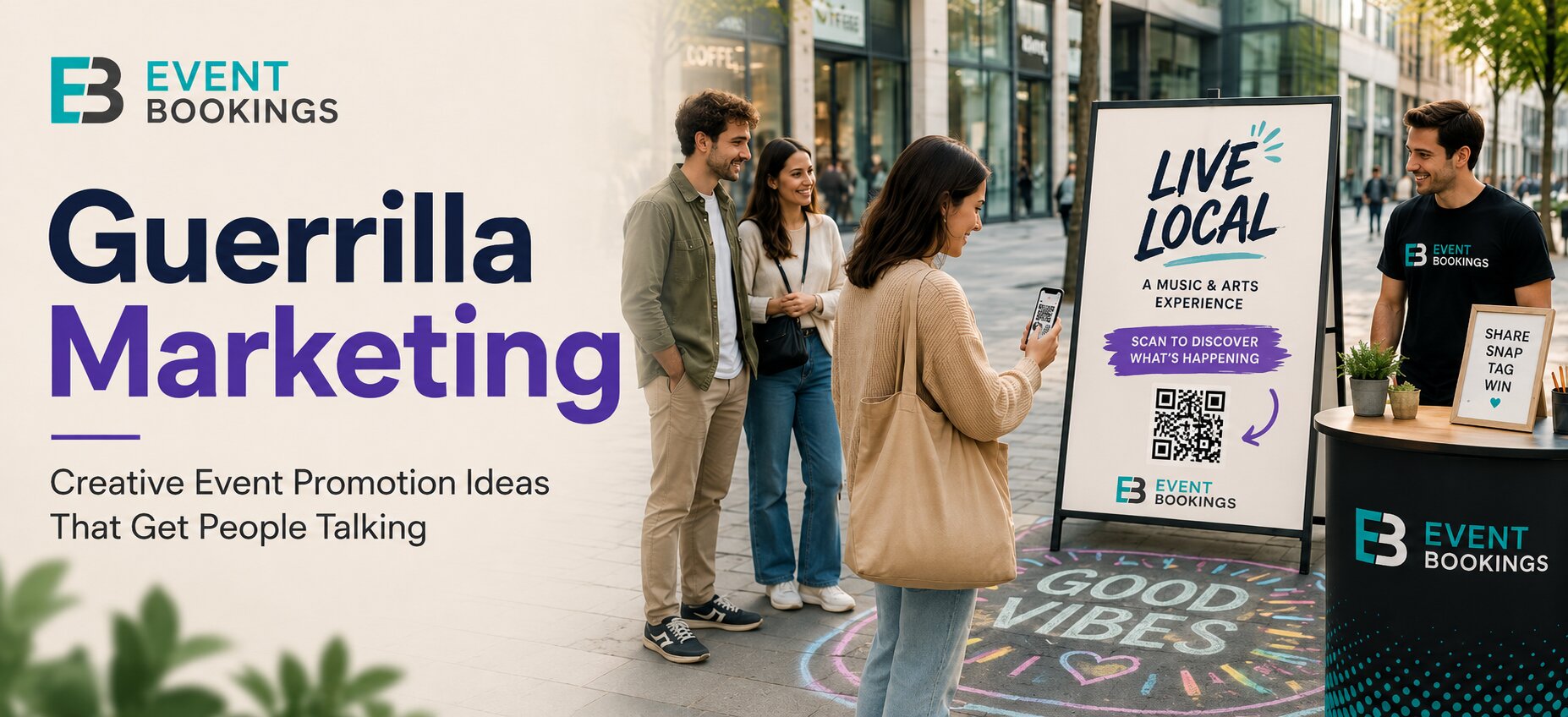
Getting noticed is challenging for event organisers, especially with limited budgets and crowded advertising channels. How do you stand out without spending much on ads?
This is where guerrilla marketing shines.
Guerrilla marketing is a creative and unconventional approach. It uses surprise, participation, public interaction, and word of mouth instead of large advertising budgets. The term grew popular after Jay Conrad Levinson’s 1984 book, Guerrilla Marketing. This strategy is still relevant because it relies on imagination, timing, audience psychology, and memorable experiences—not media spend.
Guerrilla marketing is particularly effective for event organisers, as events inherently offer real-life experiences. Creative activations, street-level ideas, social challenges, pop-up moments, community collaborations, or shareable ticket campaigns can transform your event promotion into a compelling story.
In the following sections, you’ll find a guide to guerrilla marketing—covering its definition, its strengths for event promotion, and practical steps to apply it to your next event.
What Is Guerrilla Marketing?
Guerrilla marketing is a promotional strategy that employs unexpected, low-cost, and creative tactics to capture attention and encourage sharing. Rather than purchasing additional ad space, it makes the campaign itself engaging enough to generate conversation.
Traditional marketing often asks, “Where can we place our message?”
Guerrilla marketing asks, “How can we create a moment people will remember?”
That moment might be:
- A surprise performance in a public space
- A clever poster in an unexpected location
- A branded photo opportunity
- A QR code treasure hunt
- A social media challenge
- A pop-up ticket giveaway
- A street team campaign
- A creative installation near the event venue
- A campaign that connects with a local trend, joke, or community issue
The key takeaway: Successful guerrilla marketing ties each surprise or unusual moment directly to your event, your audience, and a reason for them to care.
Why Guerrilla Marketing Works for Event Promotion
Guerrilla marketing works because it follows human behaviour. People remember surprises. They share experiences that make them laugh, feel curious, feel included, or feel as if they have discovered something first.
This matters because word of mouth remains one of the most trusted ways to promote. Nielsen’s Trust in Advertising research found that people trust recommendations from those they know more than any other advertising channel.
This is particularly relevant for events, as attendance at concerts, workshops, festivals, and similar gatherings is often driven by personal recommendations or invitations. A strong guerrilla campaign can initiate this word-of-mouth momentum.
Guerrilla marketing can help event organisers:
- Build awareness with a limited budget
You do not always need a large paid media plan. A clever local campaign can make your event visible in the right community.
- Create shareable content
People are more inclined to share content that is surprising, interactive, humorous, or visually engaging.
- Drive direct ticket sales.
Tools such as QR codes, discount codes, referral links, and limited-time offers help convert offline engagement into online ticket sales.
- Strengthen event identity
A creative campaign can convey the event experience to potential attendees before the event takes place.
- Reach local audiences
For local events, street-level and community-based tactics are often more effective than broad online advertising.
Guerrilla Marketing vs Traditional Event Marketing
Traditional event marketing typically involves paid ads, email campaigns, social media posts, press releases, SEO, posters, partnerships, and influencer outreach. While these methods are important, they can become predictable.
Guerrilla marketing introduces an element of surprise.
For example:
A traditional campaign says:
“Buy tickets to our food festival.”
A guerrilla campaign creates:
A giant empty dinner table in a public square with a QR code that says, “Your seat is waiting.”
A traditional campaign says:
“Register for our business networking event.”
A guerrilla campaign creates:
A pop-up “30-second networking booth” in a busy business district, where people exchange cards and scan a QR code for the full event.
A traditional campaign says:
“Join our charity run.”
A guerrilla campaign creates:
A chalk trail through the city showing the distance someone walks daily to access clean water, ending with a QR code to register.
Key takeaway: While traditional marketing informs, guerrilla marketing creates experiences that people want to notice, feel, discuss, photograph, or share.
Types of Guerrilla Marketing for Events
There are many forms of guerrilla marketing, but the most useful types for event organisers include the following.
1. Street Marketing
Street marketing uses public spaces to build visibility. This includes street teams, chalk art, posters, performers, branded signs, mascot appearances, or product sampling.
For events, street marketing works well when your audience is concentrated in a specific area. For example, a university event can promote around campus, a theatre show can promote near arts districts, and a business seminar can promote near coworking spaces.
Example idea:
For a comedy show, set up “serious face checkpoints” throughout the city. Participants who scan a QR code and maintain a serious expression for 10 seconds receive a discounted ticket.
2. Ambient Marketing
Ambient marketing uses existing environments in creative ways. It turns everyday surroundings into part of the message.
For example, a fitness event could put motivational signs on staircases. A music festival could place lyric-style posters near bus stops. A sustainability event could use recycling bins as campaign touchpoints.
Example idea:
For a film screening, place “movie clue” posters around nearby cafes and bookstores. Each poster reveals one clue and a QR code leading to the event page.
3. Experiential Marketing
Experiential marketing offers a preview of the event experience before ticket purchase. This approach is particularly effective for festivals, workshops, expos, classes, brand events, and community gatherings.
Example idea:
A cooking workshop could run a 10-minute pop-up tasting outside a local market and give attendees a QR code for early-bird tickets.
4. Viral Social Campaigns
Some guerrilla campaigns are built for online sharing. These campaigns often use humour, surprise, challenges, user-generated content, or public reactions.
Research into viral advertising has found that surprise and joy are common emotional features in highly shared video ads. For event organisers, this means your campaign does not need to be expensive, but it does need to create an emotional reason to share.
Example idea:
A dance event could ask people to record a 7-second version of the event’s signature move and tag the event for a chance to win VIP access.
5. Pop-Up Activations
A pop-up activation is a temporary experience created in a public or semi-public place. It could be a booth, installation, game, performance, tasting, or mini-event.
Example idea:
A business conference could create a “bad business advice booth” where people pull a card with a funny, outdated business tip, then scan a QR code to attend a session that teaches a better strategy.
6. Community-Based Guerrilla Marketing
This approach is particularly effective for local events, as it prioritizes visibility within a specific community rather than seeking global virality.
Example idea:
A school fundraiser could partner with local cafes to add small table cards saying, “This table helped fund a student project. Join the event.”
Guerrilla Marketing Ideas for Event Organisers
Below are practical guerrilla marketing ideas adaptable to various event types.
1. QR Code Treasure Hunt
Create a simple treasure hunt across local businesses, campus areas, community spaces, or partner venues. Each QR code reveals a clue, a discount code, a speaker teaser, an artist reveal, or a prize entry.
This works well for festivals, student events, community events, expos, and tourism-related events.
How to use it:
- Place QR codes in approved partner locations.
- Link each QR code to your event page or a hidden landing page.
- Offer a reward, such as early-bird pricing, a VIP upgrade, merch, or a free entry draw.
- Track each QR code separately to see which location performs best.
2. The Mystery Ticket Drop
Announce that a small number of discounted or free tickets will be hidden around the city or revealed through clues on social media.
This creates urgency and gives people a reason to follow your event updates.
Best for: concerts, theatre shows, festivals, comedy nights, youth events, and pop culture events.
3. Street Team With a Twist
While street teams are common, creativity is essential. Assign roles that align with the event theme rather than simply distributing flyers.
For example:
- A vintage fair could have promoters dressed in retro outfits.
- A wellness event could hand out “permission to pause” cards.
- A tech event could give people “future job title” cards.
- A theatre show could have actors perform short scenes in public.
Each interaction should direct people to a clear event page through a QR code or short URL. Encourage everyone you meet to scan or visit on the spot—don’t let the moment pass without an invitation to join your event.
4. Branded Photo Moment
Create a simple photo opportunity that people want to share. This does not need to be expensive. It could be a backdrop, an oversized prop, a chalk mural, a mirror decal, a neon-style sign, or a themed frame.
Example:
For a charity gala, create a “Wall of Reasons” where people write why they support the cause. Each photo shared helps spread the event message.
5. Local Business Takeover
Partner with local cafes, gyms, bookstores, coworking spaces, restaurants, or retail stores that share your audience.
Ideas include:
- Event-themed coffee cup stickers
- Table cards with QR codes
- Window decals
- Staff wearing event badges for one day
- Receipt messages
- Mini ticket giveaways
- Partner discount codes
This works well because the promotion appears in places where your audience already spends time.
6. “Pay Attention” Posters
Design posters that differ from standard event posters. Lead with curiosity rather than the event name.
Examples:
- “This poster is not the event. The event is better.”
- “You have walked past 17 boring ads today. This is not one of them.”
- “Scan this only if you like live music.”
- “Your Saturday plans are hiding here.”
- “This QR code may improve your weekend.”
Make sure the landing page immediately explains the event and allows people to register or buy tickets.
7. Mini Pop-Up Preview
Give people a small preview of the event experience.
Examples:
- A musician performs one song in a public place.
- A chef offers one bite from a cooking class.
- A speaker gives a 3-minute talk in a coworking space.
- A fitness instructor runs a 5-minute public challenge.
- An artist creates a live mini-mural.
The goal is to make people think, “I want more of this.”
8. Event Countdown in Public Spaces
Instead of only posting countdowns online, create physical countdown moments.
Examples:
- Chalk numbers on the pavement leading to the venue
- Daily window posters at partner shops
- Countdown cards in cafes
- A large community board is updated each day.
- A public installation that changes as the event gets closer
This is useful for building anticipation.
9. Referral Challenge
Turn your attendees into promoters. Offer an incentive when they invite friends.
Examples:
- Bring 3 friends and receive a merch item.
- Refer 5 people and enter a VIP draw.
- Group ticket buyers get reserved seating.
- Top referrers get backstage access or sponsor gifts.
To make this work, your ticketing setup should make sharing easy after purchase.
10. Unexpected Ticket Booth
Set up a temporary ticket booth in an unexpected but relevant location, with permission.
Examples:
- A theatre ticket booth inside a bookstore
- A fitness event booth near a park
- A startup event booth inside a coworking lobby
- A food festival booth near a farmers’ market
Add a limited-time offer for people who buy or register on the spot.
Real-World Guerrilla Marketing Lessons Event Organisers Can Learn From
Many well-known brands have used guerrilla marketing to create conversation. Bizzabo’s campaign roundup highlights how brands use surprise, cultural relevance, participation, and public moments to generate attention, including examples from entertainment, food, retail, and technology. HubSpot also notes that guerrilla marketing often works because it breaks expectations and creates memorable interactions rather than relying on standard ad formats.
For event organisers, the lesson is not to copy big-brand stunts exactly. Most events do not need a national campaign. Instead, the goal is to adapt the principles:
- Make the campaign easy to understand.
- Connect it directly to the event.
- Create a reason for people to participate.
- Make sharing simple.
- Track the result.
- Avoid ideas that could create safety, permission, or reputation issues.
A successful guerrilla campaign for a local event might be small, but it should feel intentional.
How to Plan a Guerrilla Marketing Campaign for Your Event
A creative idea is only useful if it supports your event goal. Before launching a campaign, follow this simple planning process.
Step 1: Define the Goal
Do you want to:
- Sell more tickets?
- Increase awareness?
- Grow your email list?
- Attract sponsors?
- Drive group bookings?
- Build social media engagement?
- Create local press coverage?
- Increase last-minute registrations?
Your goal will shape the campaign.
For example, if your main goal is ticket sales, every campaign asset should point to a ticket page. If your goal is awareness, you may focus more on reach, social shares, and press mentions.
Step 2: Know the Audience
Guerrilla marketing only works when it appears in the right place, at the right time, for the right people.
Ask:
- Where does your audience spend time?
- What humour, style, or message will they understand?
- What would they actually photograph or share?
- What problem does your event solve for them?
- What would make them stop for 10 seconds?
A campaign for a corporate leadership conference should look very different from a campaign for a music festival.
Step 3: Connect the Idea to the Event
The campaign should be purposeful and provide a preview of the event experience.
If your event is educational, the campaign might teach something quickly.
If your event is fun, the campaign should feel fun.
If your event is premium, the campaign should feel polished.
If your event is community-driven, the campaign should feel local and human.
Step 4: Make the Next Step Easy
Attention is not enough. People need a clear action.
Use:
- QR codes
- Short URLs
- Discount codes
- Event landing pages
- Social hashtags
- Registration forms
- Limited-time offers
- Referral links
Your event page should be mobile-friendly, clear, and ready to convert visitors into attendees.
Step 5: Track Performance
Even low-cost campaigns need measurement.
Track:
- QR code scans
- Ticket sales by promo code
- Landing page visits
- Social mentions
- Shares and comments
- Email signups
- Referral purchases
- Press coverage
- Partner location performance
This helps you understand what worked and what to improve next time.
Guerrilla Marketing Mistakes to Avoid
Guerrilla marketing can be highly effective, but poor execution may damage trust. The objective is to create positive surprise, not confusion, inconvenience, or risk.
Avoid These Mistakes:
- Ignoring permissions
Do not place posters, stickers, installations, or performers in spaces where permission is required.
- Creating safety risks
Avoid campaigns that block walkways, distract drivers, create crowding, or frighten people.
- Being unclear
If people do not understand the message, they will not take action.
- Overcomplicating the idea
A good guerrilla campaign should be simple enough to explain in one sentence.
- Forgetting the ticket link
If people cannot quickly find where to register or buy tickets, the campaign loses value.
- Using shock without purpose
Shock may get attention, but it can also create backlash if it feels insensitive or disconnected from the event.
- Not preparing your event page
If your campaign works, people will visit your event page. Make sure your ticket types, event details, refund policy, schedule, images, and registration forms are ready.
How EventBookings Helps Turn Attention Into Ticket Sales
A guerrilla campaign can create attention, but your event ticketing platform helps convert that attention into registrations, bookings, and revenue.
With EventBookings, organisers can create branded event pages, sell tickets online, manage registrations, collect attendee information, offer discounts, track orders, and check attendees in using QR codes. This makes it easier to connect a creative campaign to a smooth ticket-buying journey.
For example, you can:
- Add a QR code to posters, flyers, installations, or pop-up signage.
- Send people directly to your event page.
- Use coupon codes to track different campaign locations.
- Offer early-bird, group, VIP, or limited-time tickets.
- Collect custom attendee details during registration.
- Monitor ticket sales and attendee data.
- Use QR code check-in at the event entrance.
Guerrilla marketing creates the spark. A strong event registration and ticketing system helps capture the demand.
Guerrilla Marketing Checklist for Event Organisers
Before you launch your campaign, review this checklist:
- Is the campaign connected to the event theme?
- Is the target audience clearly defined?
- Is the location relevant?
- Do you have permission to run the activation?
- Is the idea safe and accessible?
- Is the message simple?
- Is there a clear QR code, link, or call to action?
- Is your event page ready?
- Are ticket types, pricing, and event details correct?
- Do you have a tracking method?
- Do you have a backup plan if the activation gets more attention than expected?
- Do you have someone monitoring social comments, questions, and messages?
Guerrilla Marketing Ideas by Event Type
For Music Events
- Surprise acoustic performance in a public area
- QR code posters with a hidden playlist
- “Guess the setlist” social challenge
- Limited-time street team ticket codes
- Branded photo wall near nightlife areas
For Conferences
- Pop-up expert advice booth
- Business card exchange challenge
- QR code knowledge hunt
- Coffee cup sleeve promotion near offices
- “One question every leader should answer” poster campaign
For Charity Events
- Public impact installation
- Story cards showing real beneficiary outcomes
- Community pledge wall
- Sponsor-supported ticket giveaway
- Social challenge tied to donations or registrations
For Sports Events
- Mini skills challenge in a public park
- Fan photo frame
- Local club partnership campaign
- QR code scoreboard posters
- “Bring your team” group ticket promotion
For Workshops and Classes
- Free 5-minute sample session
- Before-and-after demonstration
- Skill challenge with prize entry
- Local business flyer swap
- Limited-seat countdown campaign
For Festivals
- Citywide clue hunt
- Artist reveal posters
- Pop-up tasting or performance
- Partner venue map
- Festival wristband pre-sale challenge
Final Thoughts
Guerrilla marketing is not about having the loudest campaign. It is about creating the most memorable moment for the right audience.
For event organisers, this can be a major advantage. Every event already has a story, a theme, a community, and an experience behind it. Guerrilla marketing simply brings part of that experience into the world before the event begins.
Start small. Choose one creative idea. Make it easy to share. Link it clearly to your ticket page. Track the results. Then use what you learn to make your next campaign even stronger.
With the right idea and the right event ticketing setup, a small campaign can create big attention.